
Table Of Contents
Last Updated

Teach Yourself Hausa
Learning to Speak Hausa Language

Hello ("Sannu"). This website is dedicated to anyone interested in learning and promoting the Hausa language, the people's culture and tribe. My name is Sam Odiaka.
There aren't many resources on learning the Hausa language on the Internet (that I could find),
so I decided to put some up myself.
Before you start, may I remind you one of the famious
Hausa Proverb: Karatu, farkonka madaci, karshenka zuma ("it may be bitter to begin study
but the end is sweet")
Hausa is one of the major languages of Nigeria. It is the main lingua franca ("A medium of communication between peoples of different languages") throughout Niger and the northern two-thirds of Nigeria.
The present day Hausa people came from the Hausa Bakwai, the seven historical states of Biram, Daura, Gobir, Kano, Katsina, Rano and Zazzau (Zaria), which form the nucleus of Kano, North Central and North western states of Nigeria and the portion of Niger Republic.
At the beginning of the 19th century, the Fulani of Sokoto incorporated the governments of the
Hausa Bakwai into the Sokoto empire, the foundation of the political entity
known up to 1966 as the Northern Region of Nigeria.
The kingdom of Kanem Bornu empire, along with the remainder of present
day North Eastern, Benue-Plateau and Kwara states, remained outside the mainstream of Hausa and later Fulani influence.
Those states where Hausa was spoken but not as a mother tongue, were known as the
Banza Barkwai, the seven main ones are: Gwari, Ilorin(Yoruba), Kebbi, Kwararafa (Jukun), Nupe, Yauri and Zamfara.
Note that Gwari is a term still used to refer to people who haltingly stammers out Pigeon Hausa
(Bagwari ne). Whilst those foreigner who speaks fluent Hausa are called "Ya iya Hausa kamar jakin Kano", literally
meaning, "he speaks Hausa like a Kano donkey".
Hausa is widely used as a lingua franca by Muslim populations in other countries West of Nigeria, e.g. Benin, Togo, and Ghana.
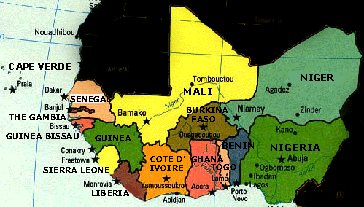
Hausa is spoken by, an estimated 22 million native speakers, plus an additional
17 million second language speaker.
The largest native speaking population is in Northern Nigeria, where Hausa is the native language of the majority of the population
and a universal lingua franca regardless of a speaker's first language.
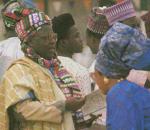
In cities outside primarily Islamic areas the zango will usually be the center of organized Islamic activities, such as Koranic schools and sites for the major Islamic festivals.
This website is written to help you feel more confident about learning the Hausa language, quickly and effectively without spending several weeks, months or even years learning new language that you will lose interest in no time! Most of all its free!
It is intended to be Fun! Enjoyable! Happiness and Laughter with friends and family, sometimes with
colleagues at work - "you teaching friends about Hausa language" with smile
 on your face.
Teach Yourself Hausa website is written to help you learn the Hausa language quickly, so that you can feel more confident hearing your relatives speaking Hausa and hears what some people are saying about you in the Hausa language. Whether they're swearing or causing you in the language, you should now KNOW.
Who is this website meant for?
Well, any body who wants to have fun quickly learning the Hausa language. As for me,
the webmaster, my mother is an Hausa (well Zangon Kataf in Tagama village) and my father, an Igbo (Ogbeobi Unodu Ibolo-Oraifite).
By putting this website I was hoping it would motivate my children and myself to learn the Hausa language.
It is also intended for people born out side Hausa land, may be your parents can speaks Hausa and
didn't have the time to teach you the language or you're now an European or African American citizens
that you wants to understand your parents' original language.
Look at this site as an introductory lesson
to the building blocks of the Hausa language.
This website contains information you can USE NOW, FAST AND EASY. The PERFECT GIFT for the family and friends.
If you enjoyed reading the contents of this site please tell your friends and the family about it - so they can have fun as well. Imagine you speaking Hausa to them? Weldone!
WHAT TO EXPECT FROM THIS WEBSITE
This site is written to help YOU speak simple words in the Hausa Language. Speaking "light hearted" Hausa words
with your face (yes! YOU) are smiling
Who's this contents website for: Beginners who really want to know how to speak Hausa quickly with out much of a fuss! This is the most easily digestible website contents ever written on the subject.
Who's this contents website NOT for: Advanced Hausa speakers. This site caters to a novice audience in an open and friendly way. If you've already mastered the basics, you won't need this website contents.
This content is written mainly in "Standard" (AREWA & AREWA) Hausa. The Hausa spoken in Kano State. But does not cover:
- Western "Classical" Hausa (spoken in Sokoto {Sakkwato} in Nigeria, Tahoua {Tawa} in Niger),
- Northern Hausa (spoken in Katsina in Nigeria and Marad' and Zinder in Niger),
- Southern Hausa (spoken in Zaria & Bausi), Eastern "Guddiri" Hausa (spoken in Had'eja, Azare & Katagum),
- Ghanian Hausa,
- Non-native Hausa
These types of subtle Hausa are not covered in this website. So, for now; teach yourself Hausa,
emphasis are on the Kano State Hausa.
As the Hausa man (not bbchausa) will say..
"Waiwaya maganin mantuwa" Which means... now that some good people
are saying the truth, more good people should speak up. Let us as a region re-trace our steps back to where things began
to go wrong.
It doesn't matter whether you teach yourself swahili, igbo, hausa fulani or voa hausa. Truth must be said
at all times.
BBC Hausa Service BBC HAUSA COM
The Bbc hausa.com
(or BBC World Service Hausa based
in London UK) offer bbchausa services on its international news website www.bbchausa.com using Kananci (Kano dialect as the standard).
There are a number of gists/gossip and stories connected with the Hausa people, who today live in northern Nigeria,
parts of Ghana, Niger and Togo of which the BBC's Hausa Service (bbc hausa com or bbchausa) broadcast to.
BIBISI Hausa
coverage of the Africa Cup of Nations
The Bibisi hausa.com (radio bibisi) World Service has in-depth coverage of the Africa Cup of Nations from group stages
to the final on 31 January.
The bibisi hausa website www.bbc hausa.com does have team news, statistics and match reports for every game and live text
commentary from the opening match, semi-finals and final.
Bibisi hausa (or bbchausa) usually follows the progress of all African teams including Nigeria's Super Eagles and catching
up with fans who have made the long journey from west Africa while BBC Portuguese for Africa will cover the tournament in each of
the services three daily broadcasts.
Radio Deutsche Welle Hausa and
Voice of America Listen Online
In addition Deutsche Welle
www.dw-world.de/hausa radio deutsche welle hausa - the analysis & opinion of German
and European breaking news from Germany's international broadcaster and
Voice of America listen online
www.voanews.com/hausa also offer Hausa services on
its international news websites using Kananci.
In Nigeria, standard Hausa are the most heard in broadcast media, including both Nigerian radio and television and international Hausa broadcasting, such as the BBC Hausa.COM, Deutsche Welle, The Voice of America (VOA) Hausa, Aljazeera hausa and others.
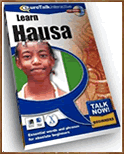
Essential Words and Phrases for Absolute Beginners!
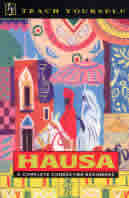
Charles H. Kraft &
A.H.M. Kirk-Greene's
Teach Yourself Hausa - A Complete Course For Beginners